The VDWS system splits kitesurfing into seven progressive levels, from first kite contact on land to jumping and freestyle. Levels 1 to 3 are the beginner block, Levels 4 and 5 take you to independent upwind riding and self-rescue, and Levels 6 and 7 cover transitions, toeside and jumping. Most people reach independence somewhere between fifteen and twenty-five hours of tuition.
How the VDWS structure works
VDWS is a German-founded training system used across watersports schools in Europe, North Africa and beyond. We teach it rather than IKO. Its value to you as a student is that your progress is logged against defined competencies, and the licence it issues is recognised by rental centres and schools internationally — which is exactly what you need if you want to hire gear on your next trip without an assessment ride.
Two honest caveats. First, schools split the level boundaries slightly differently, so a Level 4 at one centre may be described as late Level 3 at another. The competencies matter more than the numbers. Second, hours per level vary enormously between individuals. The ranges below are typical, not promised.
Levels 1 to 3: the beginner block
Level 1: theory, safety and kite control on land
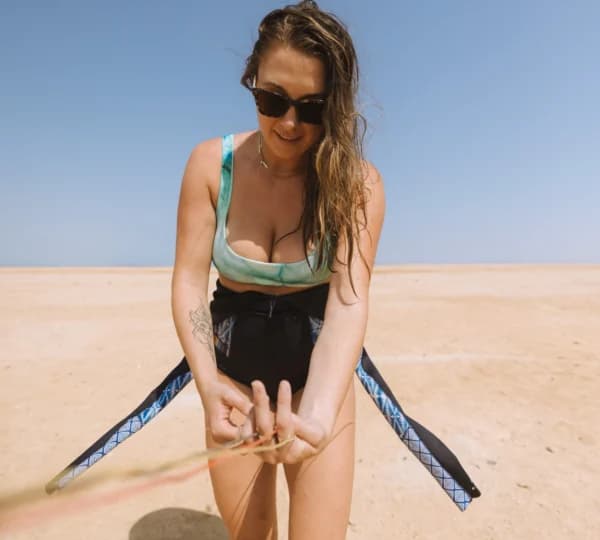
You start on the sand. Wind window, depower, the chicken loop and quick release, the safety leash, rigging and pre-flight checks, launching and landing with an assistant, and steering a kite through the window without oversteering. You will practise the quick release until it is reflexive.
Typical hours: 2 to 4.
Level 2: kite control in the water
Same skills, harder environment. Flying the kite while standing in waist-deep water, recovering a kite that has crashed onto the surface, and the first water relaunch — which is a genuine milestone and takes most people several attempts.
Typical hours: 2 to 4.
Level 3: body dragging and board recovery
Downwind body drags on both sides, then directional body dragging with one arm extended, which is how you retrieve a board you have lost. You will also learn to walk upwind along the beach, which is unglamorous and completely necessary.
Typical hours: 3 to 5.
At the end of Level 3 you can control a kite in any part of the window, relaunch it from the water, and get yourself and a lost board back to shore. That is the safety foundation. The board comes next.
Levels 4 and 5: becoming independent
Level 4: the water start and first rides
The board finally appears. You learn the body position for a water start, the timing of the kite dive that generates the pull, how to get up and stay up on both tacks, and how to stop under control. Expect to fail repeatedly for an hour and then suddenly get it, which is how nearly everyone experiences this level.
Typical hours: 4 to 8.
Level 5: riding upwind and self-rescue
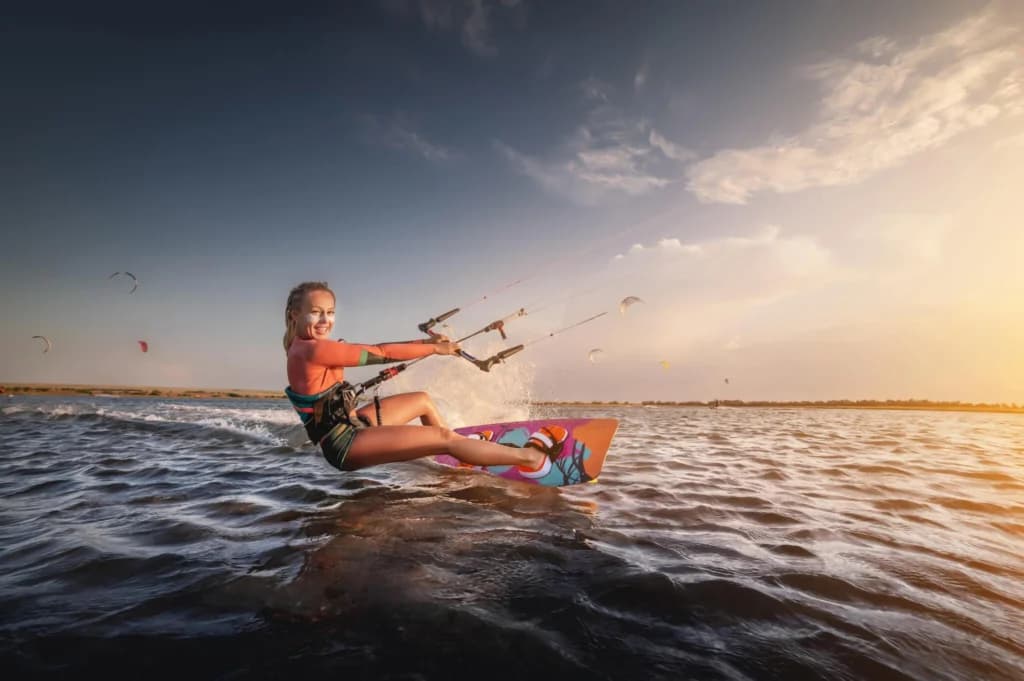
The most important level in the whole system. You learn to hold an edge, ride upwind rather than sliding down the beach, execute a controlled stop and a self-landing, and complete a full self-rescue in deep water. You also cover right of way rules and how to assess a spot before launching.
Typical hours: 5 to 10.
Level 5 is the independence line. Once you ride upwind reliably and can self-rescue, you can hire equipment at most centres in the world and ride without supervision. It is also the minimum level for a kite safari, because you launch from a tender with deep water and current around you rather than from a beach with a lagoon downwind.
Levels 6 and 7: intermediate to advanced
Level 6: transitions, toeside and first hops
Riding switch, carving transitions in both directions, riding toeside, one-handed riding, and the first controlled hops using kite lift rather than a proper pop. This is where riding starts to feel like a sport rather than a survival exercise.
Typical hours: 6 to 12, and many riders progress here through practice rather than lessons.
Level 7: jumping and beyond
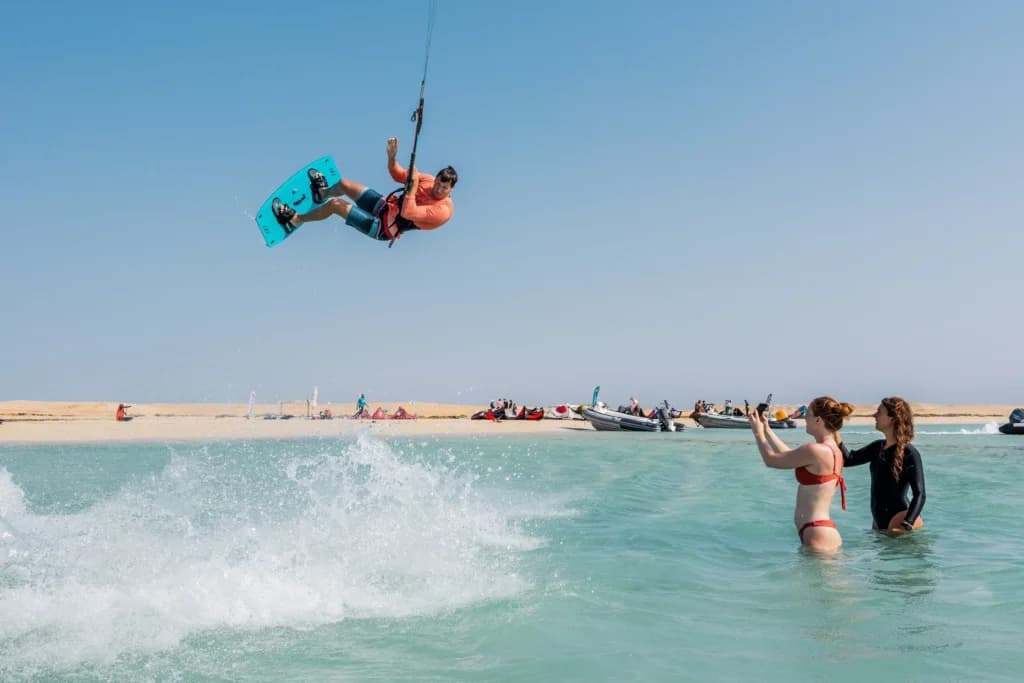
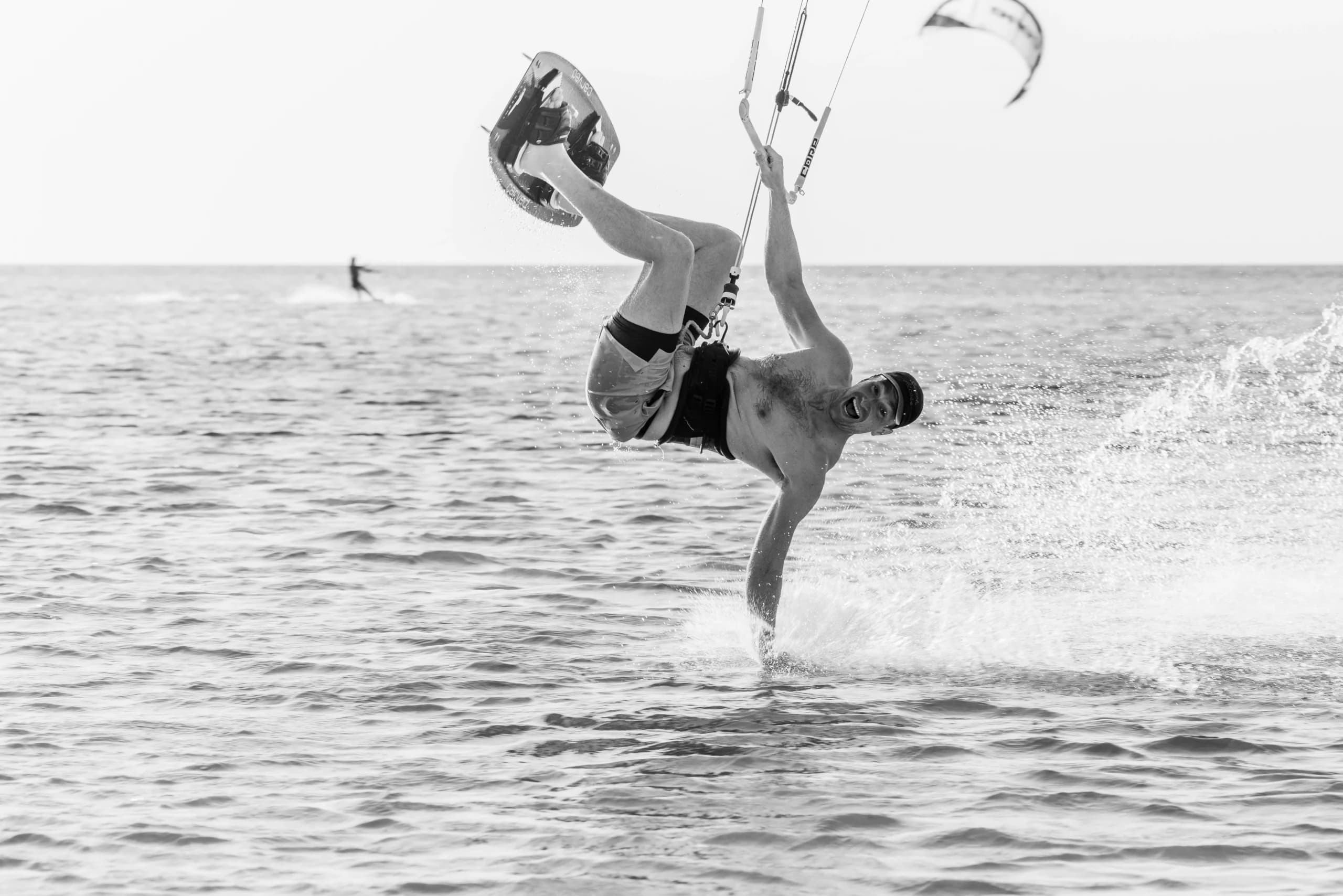
Proper jumping technique — edging hard, sending the kite, controlling rotation, and landing with the kite in the right position and the board pointing downwind. From there the syllabus branches into freestyle basics, board-offs, and unhooked riding depending on your interest.
Typical hours: open-ended. Nobody finishes Level 7; they just get better at it.
When is the licence issued?
The VDWS kiteboarding licence is issued when you can demonstrate independent riding — riding upwind under control on both tacks, self-landing and self-rescue — together with the theory element covering wind, safety and right of way. In practice that is around the end of Level 5.
Do not fixate on collecting the card in the shortest possible time. Rental centres will assess your actual riding regardless, and a licence with weak upwind riding behind it fools nobody for longer than one session.
Which format buys you the most progress?
The variable that matters is how many minutes the kite spends in your hands.
- Private: fastest progression, typically compressing the beginner block by several hours. Worth it most in Levels 1 and 4, where the concepts are hardest
- Semi-private: two students, roughly half the kite time, at a lower cost per hour. A reasonable default for Levels 2 and 3
- Group: lowest cost per hour, most standing around. Fine for confident learners and for social trips, slower for everyone else
Many riders take private lessons for the first two sessions to build clean safety habits, then move to a semi-private or group format once they are body dragging comfortably. That is usually the best value across a whole course.
Refreshers and the five-years-ago problem
If you learned once and have not ridden since, do not simply hire gear. Kite technology has changed substantially and, more importantly, your safety reflexes have not been used in years. A single two-hour refresher session covers the modern safety systems, re-establishes your water relaunch and self-rescue, and gets you signed off for rental.
Riders who skip that step are the most common source of avoidable incidents on any beach, because they have the confidence of experience and the reflexes of a beginner.
Practical notes for booking
- Courses at our school run Levels 1 through 7, and equipment is included: kite, board, harness, helmet and water booties
- Minimum age is 8, with kite size and conditions matched to a light rider
- Lessons run in Arabic, English, German, Polish and Russian
- Hotel transfer inside Hurghada is free; Makadi, Sahl Hasheesh and El Gouna carry a €20 per car surcharge
- Independent riders who do not need instruction can use the day-use programme instead
- vdws
- course levels
- beginner
- progression