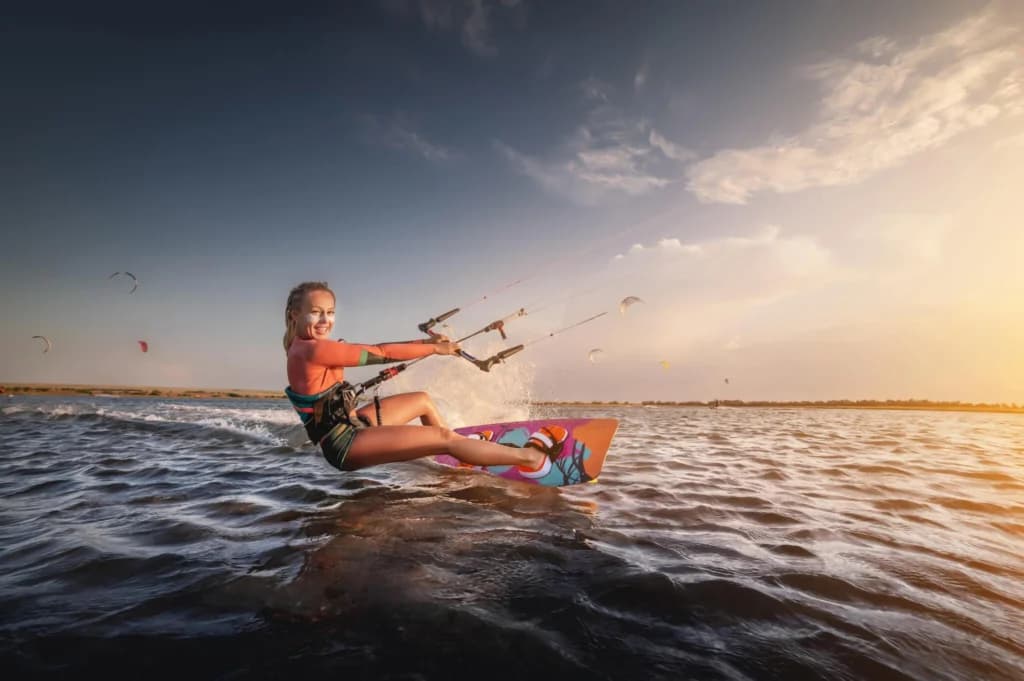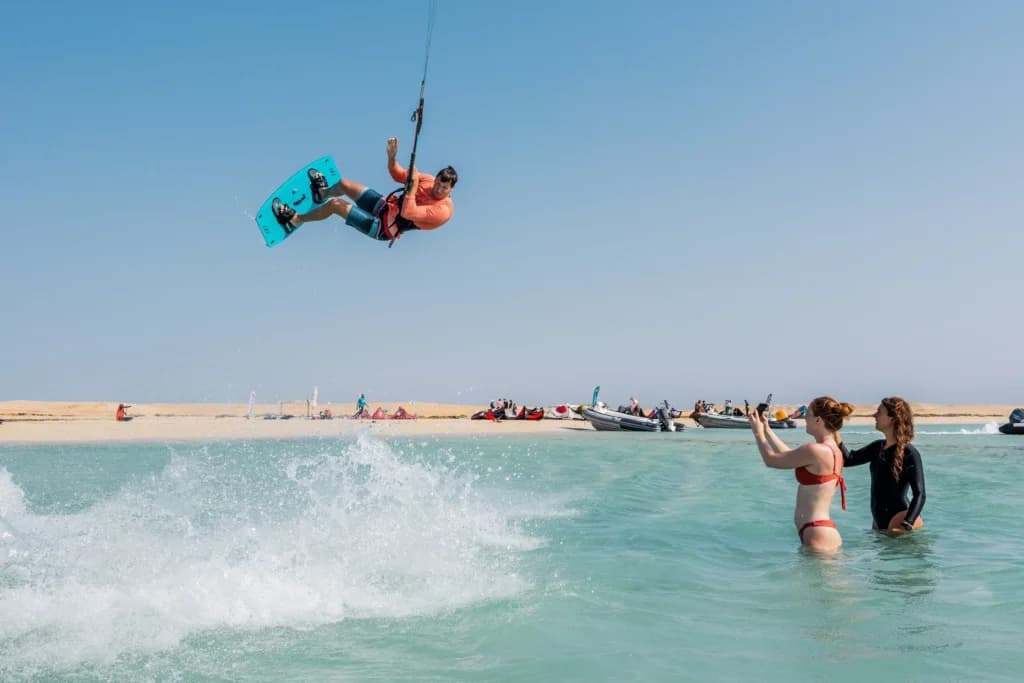
Hurghada is one of the most forgiving places in the world to learn kitesurfing: waist-deep lagoons you can stand up in, water that never drops below roughly 22°C, and a northerly wind that blows on four to six days out of seven through the summer. Most people starting from zero are riding their first independent stretches after eight to twelve hours of tuition, usually spread across three to five days. This guide covers why the spot works, what a beginner course involves, and what to sort out before you fly.
What makes Hurghada good for a first kite course
Three things matter when you are learning, and this coastline has all three at once.
The first is standing depth. The training lagoons around Hurghada stay knee- to waist-deep for hundreds of metres offshore. When you drop the kite, you stand up, untwist your lines and relaunch instead of swimming. That single detail is worth hours of progress, because beginners in deep water spend most of their energy staying afloat rather than learning.
The second is water temperature. It sits around 22 to 24°C in January and February and climbs to 28 or 29°C by August and September. In summer you learn in board shorts and a lycra. In winter a shorty or a 3/2 mm suit is plenty. You never lose a session to cold, and cold is what cuts beginner sessions short almost everywhere else.
The third is wind you can plan around, which is worth its own section.
How the Red Sea wind actually behaves
The prevailing wind along this coast is northerly to north-westerly. It is a gradient flow funnelled down the Gulf of Suez, squeezed and accelerated through the Strait of Gubal, then fanned out across the bay in front of Hurghada. A strong daily thermal sits on top of it: the desert inland heats through the morning, air rises, and sea air is drawn in to replace it.
For your lesson planning that produces a fairly predictable daily shape.
- Mornings are often light, roughly 8 to 14 knots, sometimes glassy
- The wind fills in between about 10:00 and 13:00
- Mid-afternoon is the strongest part of the day, typically 15 to 25 knots in season
- It softens again in the last hour or two before sunset
Season matters as much as time of day. May through September is the most dependable stretch. March through May often produces the strongest averages of the year but also carries the risk of khamsin, a hot dusty southerly that arrives with poor visibility and unstable gusts, usually for a day or two at a time. November through February is the quiet season: expect wind on closer to half the days, lighter on average, with more southerly interruptions.
If you have a fixed one-week holiday, start your course on day one or two. That leaves room to reschedule a light-wind day without running out of holiday.
How long does it take to learn to kitesurf?
From no experience at all, the honest averages look like this.
- Two to three hours: kite theory, the wind window, safety systems, rigging, and flying a kite on land
- Four to six hours: controlled body dragging, water relaunch, recovering your board without a leash
- Eight to twelve hours: first water starts and your first rides in both directions
- Fifteen to twenty-five hours: riding upwind consistently, which is the point you become genuinely independent
Those are averages, not promises. Board sport experience, fitness, age and — more than anything — how many consecutive days you can train all move the number. Two hours a day for five days beats ten hours crammed into a weekend, because the coordination has to consolidate overnight.
What a VDWS beginner course involves
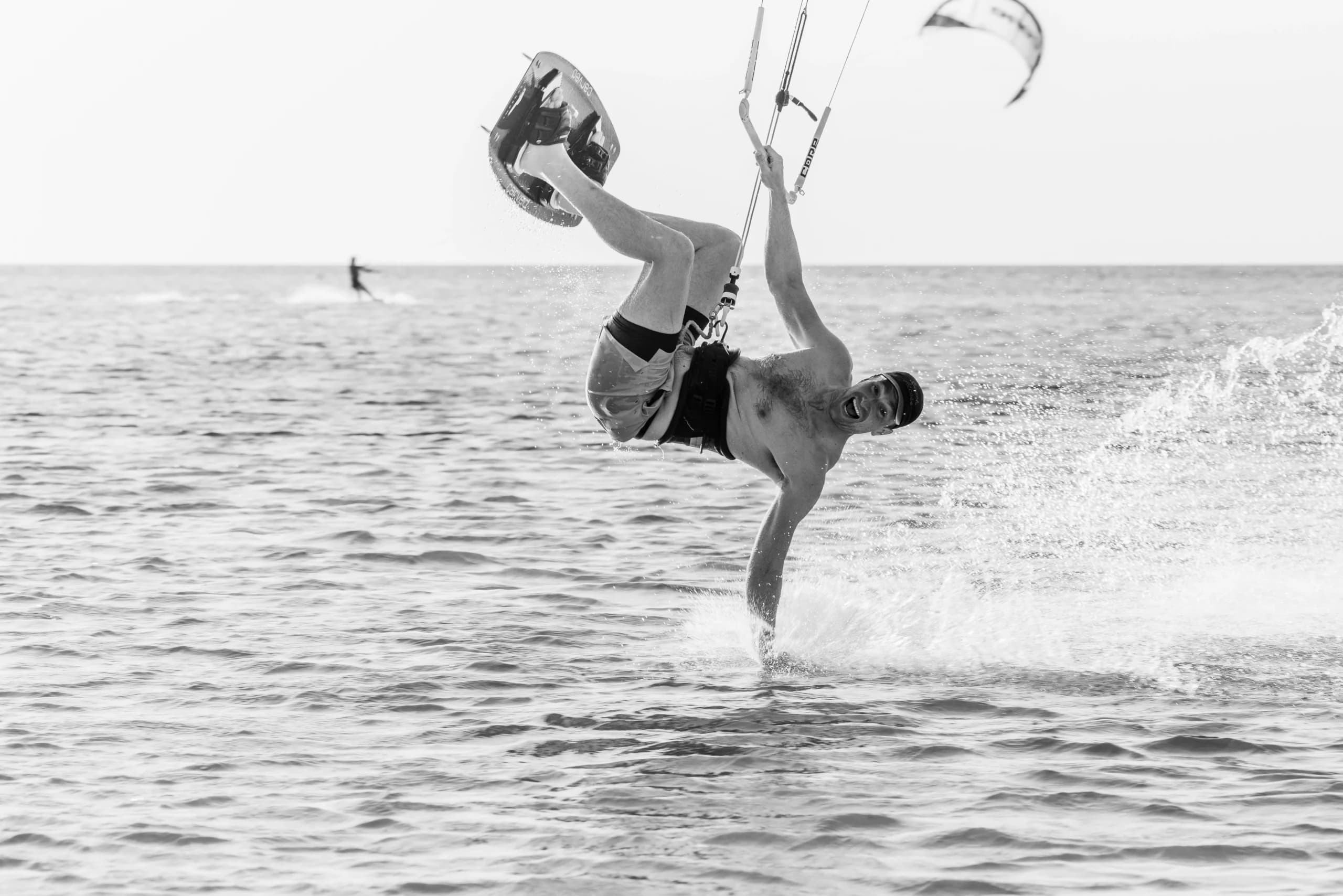
We teach the VDWS system rather than IKO, which structures kitesurfing into progressive levels. Levels 1 to 3 are the beginner block: kite handling, safety and self-rescue, body dragging, board recovery and first water starts. Levels 4 and 5 take you to independent upwind riding. Levels 6 and 7 cover transitions, toeside and jumping.
A session typically runs two to three hours, which is about as long as a beginner can concentrate in Red Sea heat. Group size is the number that actually decides how much progress you make, because in a large group you spend most of the session watching someone else fly the kite. Ask any school you are considering what their instructor-to-student ratio is on the water, not on paper.
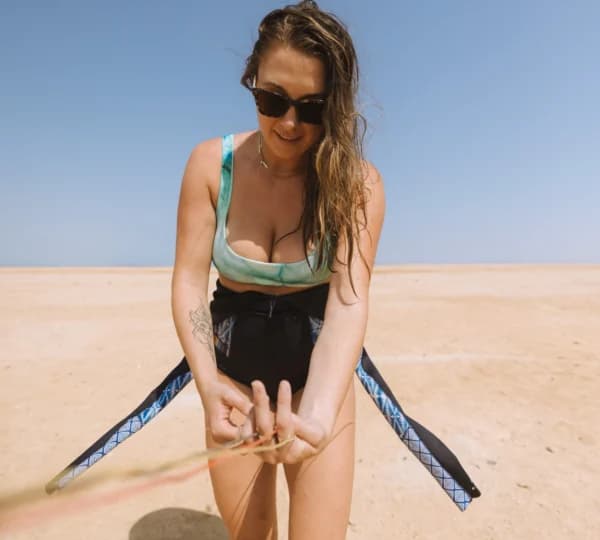
Equipment is included in our courses — kite, bar and lines, board, harness, helmet and water booties. The booties are not a courtesy item, as the next section explains.
Where you will ride as you progress
Hurghada is a base rather than a single beach. As your level climbs, the spot list opens up.
- Shallow lagoons along the Hurghada coast, the standard teaching ground, flat and standing depth
- Abu Mungar (Abu Moungar), a low sandy island just north of town with a shallow turquoise lagoon on its lee side, reached by boat, and a classic first proper spot once you ride upwind
- Gessum, sandbank and lagoon terrain in the same island group, popular for flat-water sessions
- El Gouna, 25 km north, a wide sandy bay with a big kite scene and equally big crowds in high season
- Soma Bay and Safaga, roughly 45 to 60 km south, known for broad flat bays and reliably strong wind
- Giftun Island, offshore from Hurghada, mainly a marine park snorkelling destination with sandy stretches used on boat days
- Tawila Island and the Ashrafi group, further north in the Strait of Gubal, uninhabited, and the reason kite safaris exist at all
Which of these you actually visit depends on your level, the day's wind angle and the boat schedule. No operator can honestly promise a specific island a week in advance.
Reef, sun and the things that catch beginners out
The Red Sea is a coral sea. Even in sandy lagoons there are reef patches, sea urchins and the occasional stonefish or weever buried in the sand. Water booties solve nearly all of it, and you should wear them every session, including on days when the bottom looks clean.
Sun is the more underrated hazard. Summer UV here regularly reaches index 11 or 12. A long-sleeve rash vest, reef-safe SPF 50 on your face and the backs of your hands, and around two litres of water per session is the baseline. Heat exhaustion ends far more July sessions than lack of wind does.
The water off Hurghada is also busy with dive boats and safari boats running to the reefs. Stay inside the school's marked area, learn where the launch corridor sits, and do not drift downwind of the buoys because the water looks nicer over there.
Practical planning before you fly
- Airport: Hurghada International (HRG) is a 10 to 20 minute drive from most of town
- Transfers: hotel pick-up and drop-off is free within Hurghada; Makadi, Sahl Hasheesh and El Gouna carry a €20 per car surcharge
- Minimum age: 8 years old, with the caveat that kite size and conditions have to suit a light rider
- Languages: lessons run in Arabic, English, German, Polish and Russian
- Insurance: check your travel policy covers kitesurfing by name, because many exclude it as an extreme sport
- Already independent: the day-use programme covers equipment, launch area and supervision without lessons
Book the course rather than the calendar. If the forecast collapses, a good school moves your hours instead of burning them. Ask about the no-wind policy before you pay, not afterwards.
- beginner
- hurghada
- vdws
- learn to kite