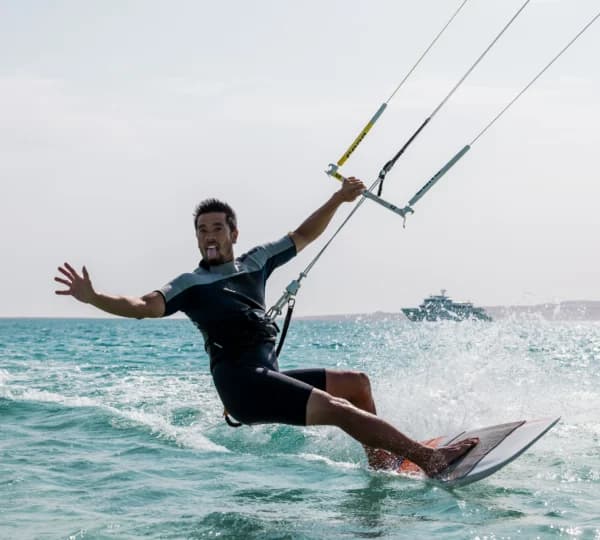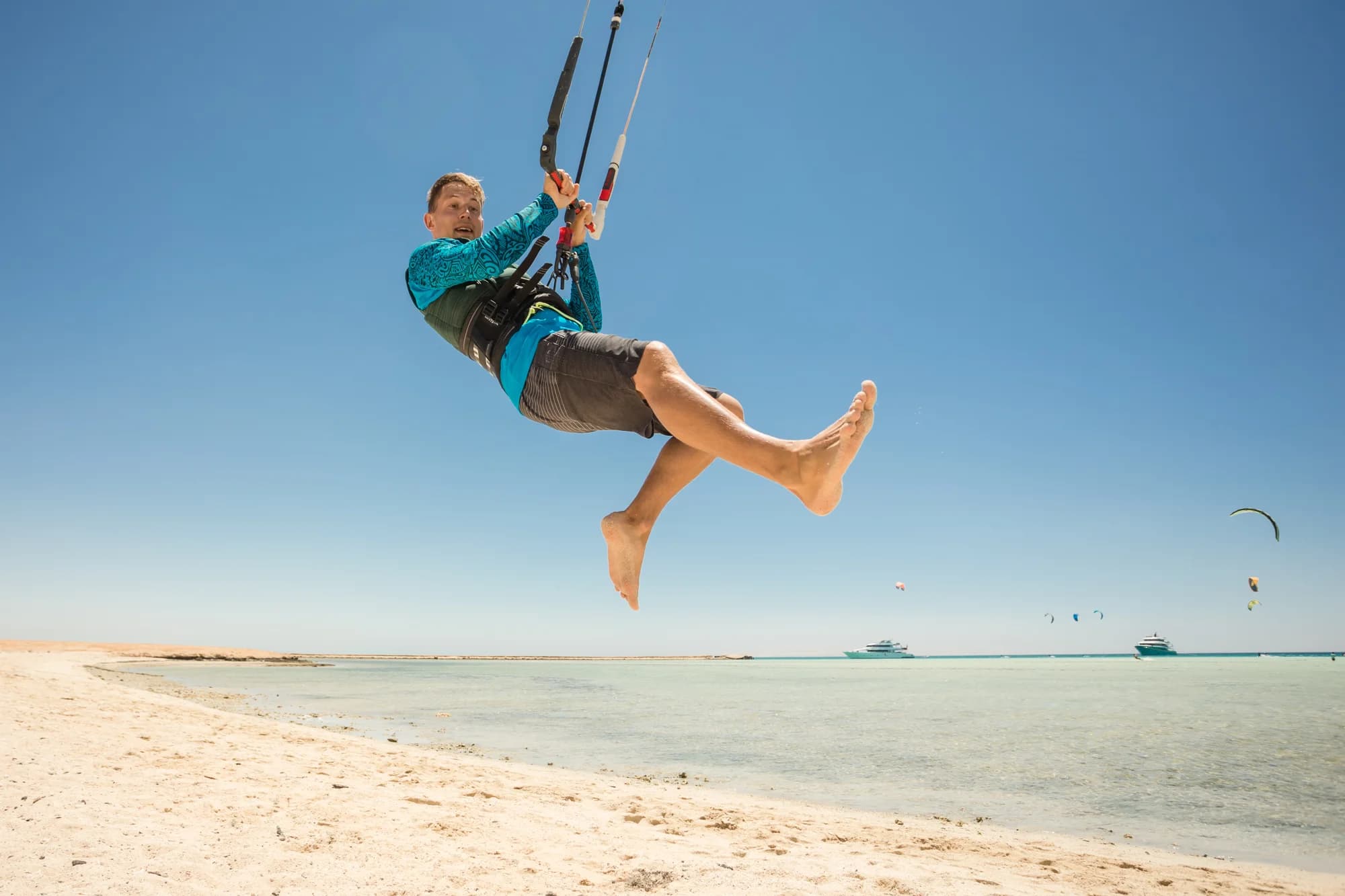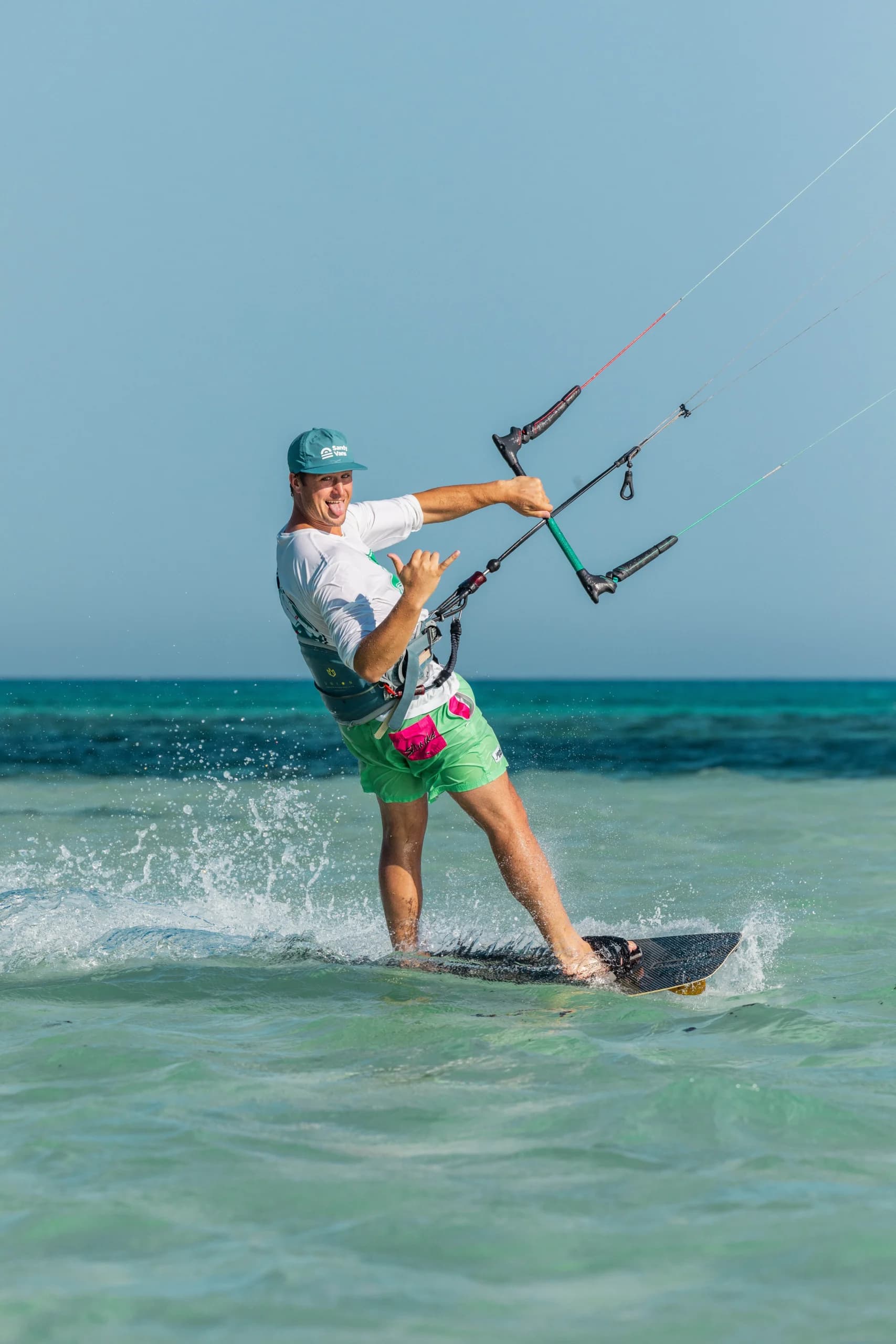
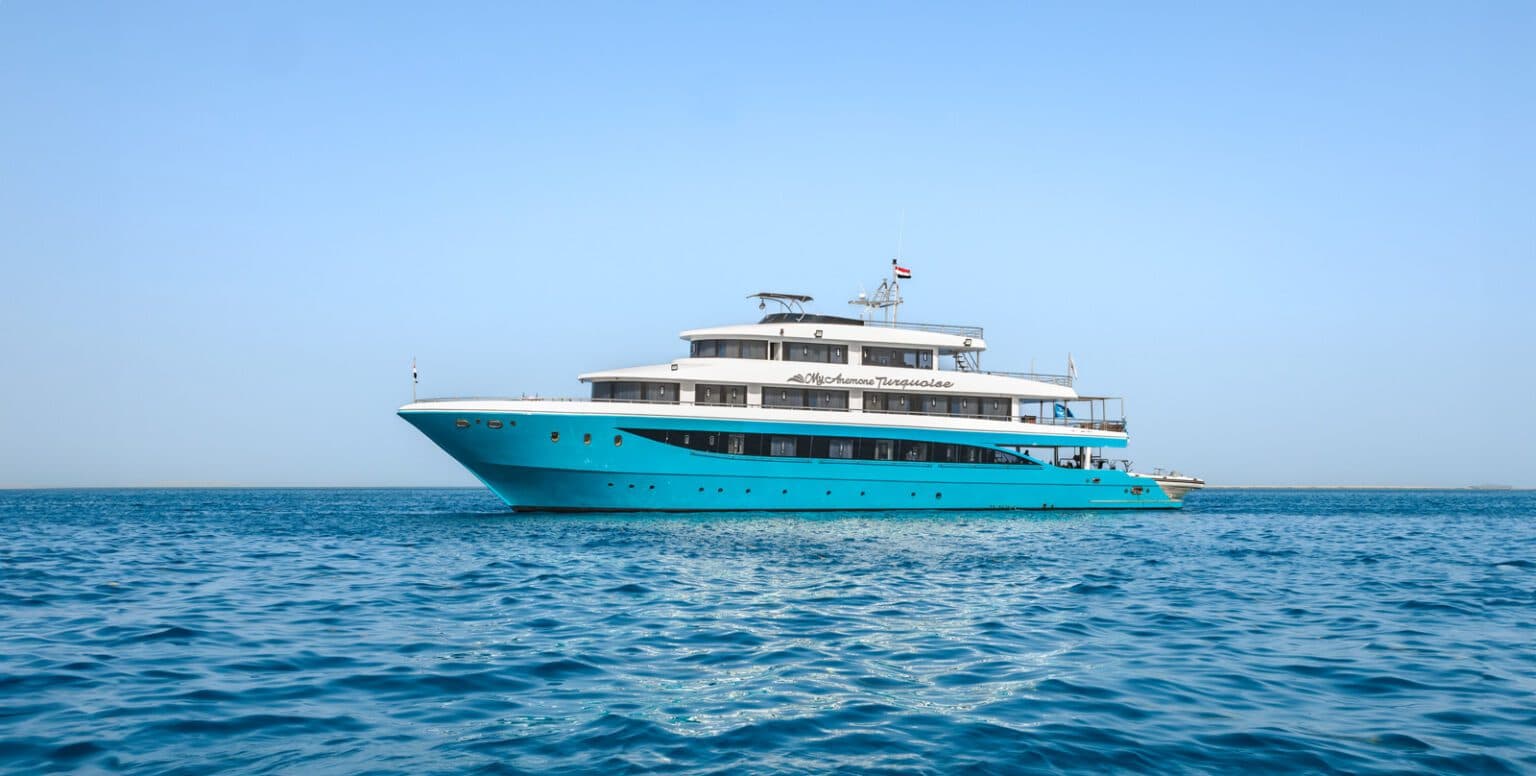
A Red Sea kite safari is a liveaboard boat trip that uses a dive-style vessel as a floating base to reach uninhabited island lagoons in the Strait of Gubal. A typical departure runs seven nights out of Hurghada with five or six riding days, and you kite from sandbanks and shallow flats that have no road access and usually no other people. The trade-off is that you need to be genuinely independent on the water before you can join one.
What a kite safari actually is
The boat is your hotel, restaurant, gear store and transport. You sleep in a cabin, eat on board, and move between anchorages overnight or during light-wind hours. Tenders — usually rigid inflatables — drop you and your gear onto a sandbank or into a lagoon, then sit on the water while you ride.
The point of the format is access. The islands north of Hurghada have turquoise lagoons with flat, standing-depth water on their leeward sides, but no infrastructure. You cannot drive to them. A boat is the only practical way to ride them, and a boat that stays out for a week is the only way to ride them repeatedly with the right wind angle.
The northern route through the Strait of Gubal
Most kite safaris out of Hurghada head north into the Strait of Gubal, the passage where the Gulf of Suez narrows before opening into the Red Sea proper. This is not an accident of scenery. The strait compresses and accelerates the prevailing northerly flow, which is why it is consistently the windiest water in the region.
The stops that recur on most northern itineraries:
- Tawila Island, a long low sandy island with extensive shallow flats on its lee side and the classic centrepiece of the route
- The Ashrafi group, a scatter of small islands and reefs near the old lighthouse, exposed and usually windy
- Gubal Island and Gubal Seghir, at the mouth of the strait
- Shadwan (Shaker) Island, the largest island in the area, on longer itineraries
- Gessum and the Abu Mungar area, closer to Hurghada, often used on the first or last day
An honest caveat that applies to every operator on this coast: the itinerary is a plan, not a contract. Wind angle, sea state, coastguard permissions and other boats all move a schedule. A good cruise director will change the route to find you wind rather than sticking to a printed list. If a brochure guarantees specific islands on specific days, treat that as marketing.
A realistic day on board
The rhythm settles by day two.
- Breakfast around 07:30, usually at anchor
- Morning briefing: where you are, what the wind is doing, when the first tender leaves
- First session mid-to-late morning if the wind has filled in, otherwise a snorkel or a move to another anchorage
- Lunch on board, then the main session block through the strongest part of the afternoon
- A late session or a downwinder before the light goes
- Dinner, gear drying, and a repositioning move overnight or at dusk
Three to four hours on the water a day is normal. Some people ride more, most ride less by day four because arms and legs give out before the wind does. Nobody talks about how tiring a full week of unlimited riding is until they have done one.
What level do you need to join?
This is the question that matters most, and the honest answer is stricter than people hope.
You should be able to:
- Water start reliably on both tacks
- Ride upwind consistently, not just occasionally
- Self-land and water relaunch without help
- Perform a full self-rescue and pack down your kite in open water
- Judge your own kite size without being told
In VDWS terms that is roughly Level 5 and above. The reason is structural: you are being launched off a boat or a sandbank with deep water and current around you, not off a beach with a lagoon downwind. If you cannot hold upwind, you drift, and every drift costs a tender pickup that pulls safety cover away from everyone else.
If you are not there yet, the sensible sequence is a shore-based course in Hurghada first, then a safari the following season or later in the same trip. Some boats accept improvers with private coaching on board; ask specifically rather than assuming.
Wind and season for safaris
The practical safari window on the northern route is roughly May to September, with the shoulders of April and October depending on the boat and the year. Summer gives the most consistent northerly flow and the warmest water, around 27 to 29°C, which matters when you are in and out of the sea eight times a day.
Sea state in the strait is usually wind chop rather than ocean swell, because the fetch is limited. That said, the channel between Gubal and the Sinai side can build a short, steep chop in a strong afternoon northerly, and current runs through the narrows. It is not flat-water conditions everywhere — the flat water is in the lees, which is exactly what the boat exists to find.
The boat, the cabins and non-riders
Most kite safari vessels in Egypt are converted or purpose-built liveaboards in the region of 35 to 40 m, carrying somewhere around 16 to 24 guests across ensuite cabins on two or three decks. Expect air conditioning, a shaded upper deck, a saloon, and freshwater from an onboard desalination plant, which is drinkable for washing but usually not for drinking.
Non-riders are generally welcome and often have a better week than they expect. The same anchorages that produce flat-water kiting sit next to some of the best snorkelling in the northern Red Sea, and several classic wreck and reef sites are in the same area. Confirm with the operator whether diving is offered, because that varies boat by boat.
Things worth checking in advance because they genuinely differ between vessels: cabin configuration and berth type, whether there is a compressor and dive guide on board, connectivity, power sockets and inverter capacity, and how many tenders run for the kite operation. Two tenders for twenty riders is comfortable; one is not.
Costs, inclusions and preparation
What is usually included, and what is not
Generally included: cabin, all meals and soft drinks, drinking water, tender transfers, crew, and the kite operation itself.
Generally not included: flights, your kite equipment, marine park and port fees, alcohol, crew tip, travel insurance, and any equipment rental. Some boats have a small rental fleet on board and some carry none at all, so if you plan to rent rather than bring gear, confirm this before booking rather than at the marina.
Practical preparation
Bring a two-kite quiver that covers the season honestly — for a 75 kg rider that usually means a 9 m and a 12 m — plus a spare bar and lines, a repair kit, and spare fins and screws. There is no shop at Tawila. Bring seasickness tablets even if you think you do not need them, and start taking them before departure rather than after the first swell.
Travel insurance is the item people skip and should not. Check that your policy names kitesurfing and covers medical evacuation from a vessel at sea, because a standard holiday policy typically covers neither.
- liveaboard
- safari
- gubal
- tawila
- red sea