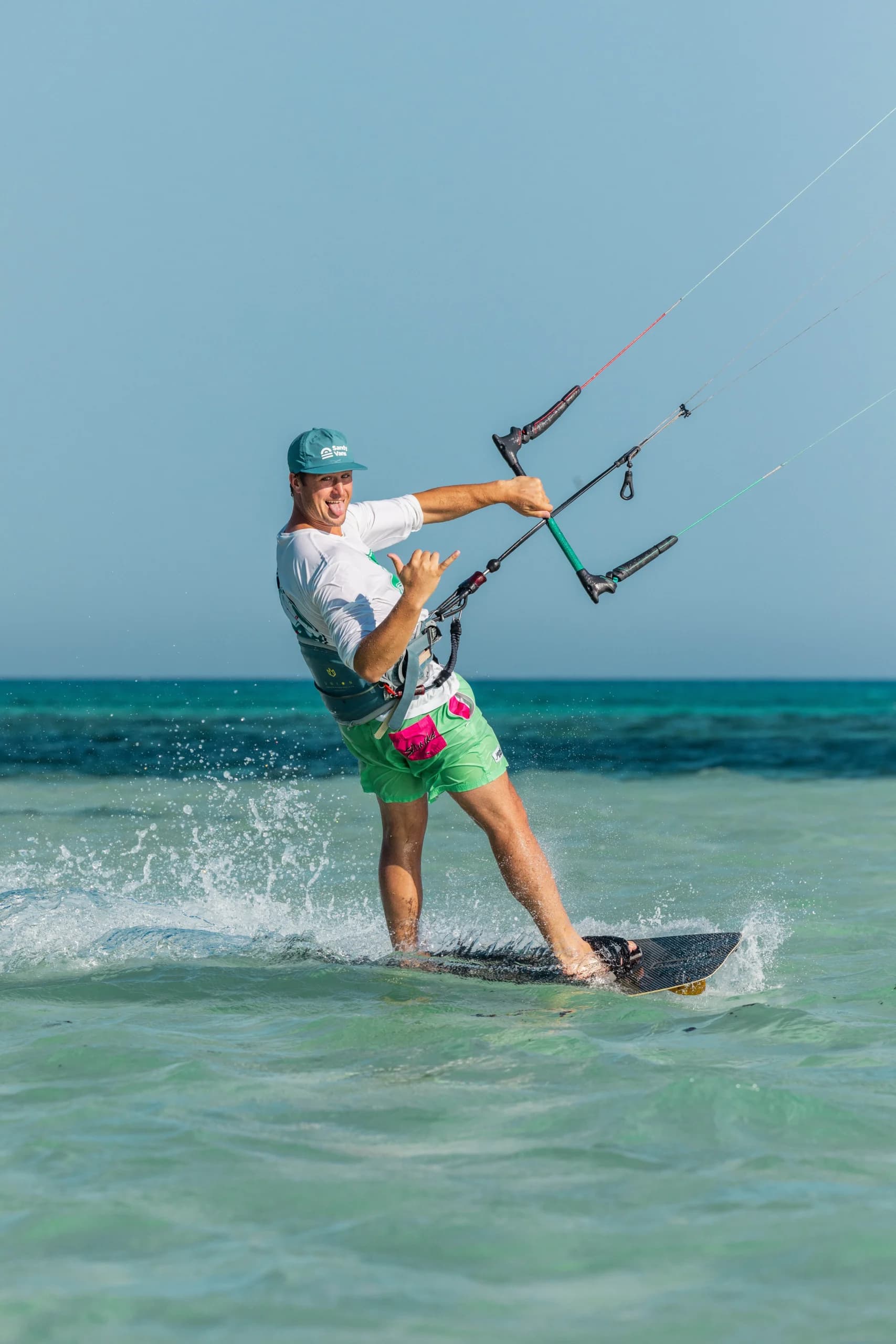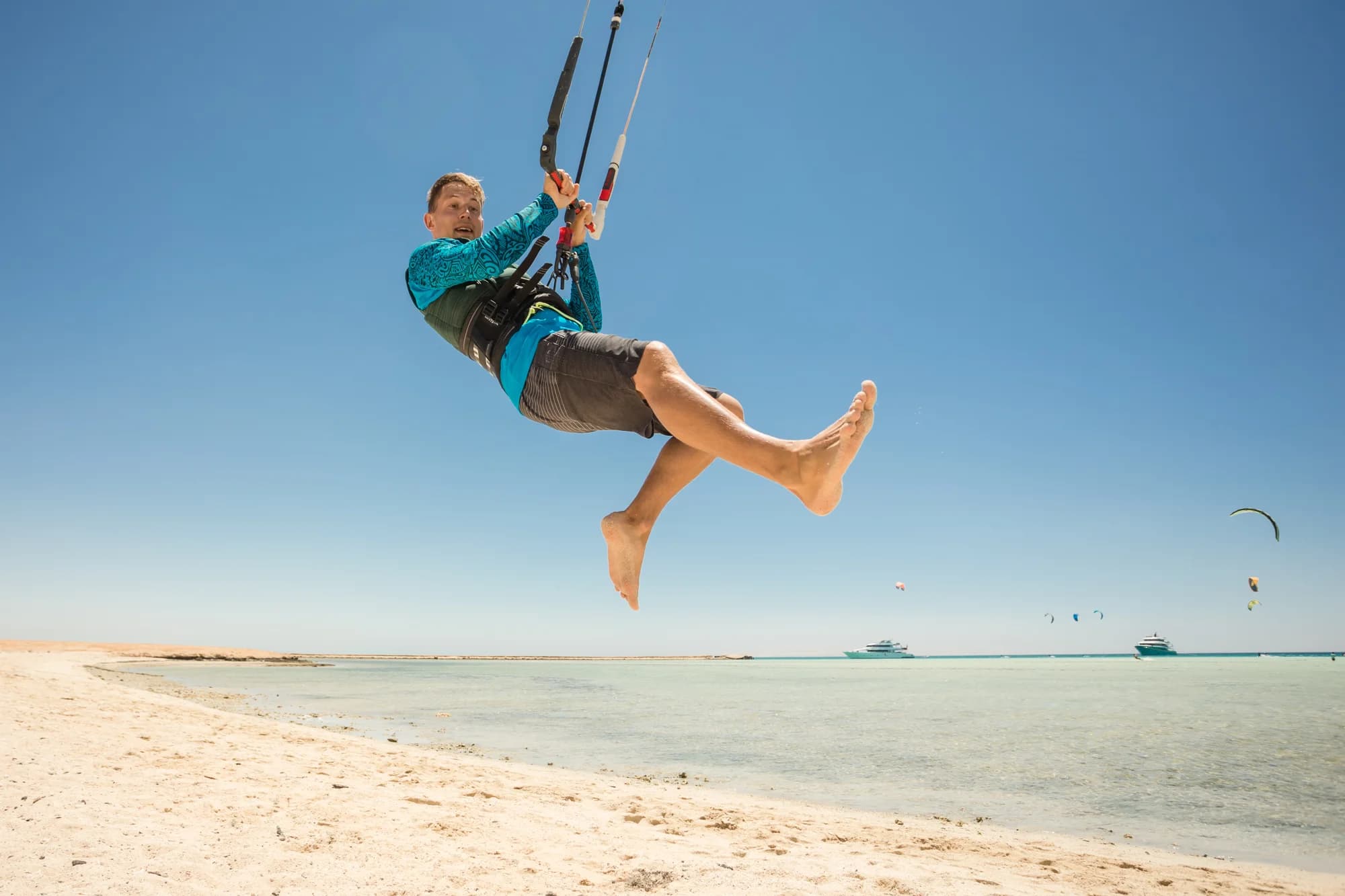
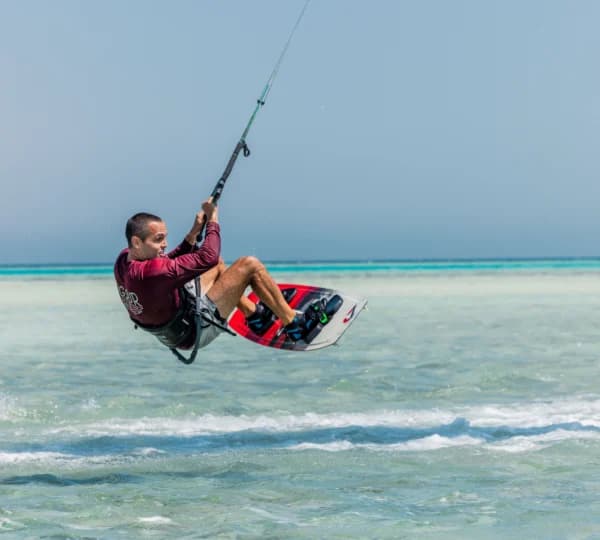
Renting kite equipment in Hurghada means picking up a matched kite, bar, board and harness from a centre for a day or a week, riding within a supervised area, and leaving a deposit against damage. Almost every centre will ask for proof that you ride upwind independently before handing over gear, and almost every centre charges for reef damage that you caused. Those two facts explain most of what follows.
What is actually in a rental package
A standard day rental should include:
- A kite in the size that matches the day's wind and your weight, with bar and lines already matched to that kite
- A twintip board with fins and pads fitted
- A harness, seat or waist depending on preference and fit
- A pump, usually shared rather than issued individually
- Access to the launch area, wash-down and storage
- Some level of on-water supervision or a rescue boat, which varies substantially by operator
What is normally not included: helmet and impact vest at some centres, damage waiver, and any kind of insurance for injury. Ask about all three before you pay.
A note on scope. Rental and lessons are different products. Our courses include equipment as part of the course price; the day-use programme covers equipment, launch area and supervision for riders who no longer need instruction. If you are between the two — riding but not consistently upwind — say so honestly. Getting rescued repeatedly costs everyone more than a supervised session would have.
Why centres ask for a licence or a check ride
Renting to someone who cannot ride upwind means the centre is committing a rescue boat to them for the whole session. Most centres therefore ask for one of two things: a recognised certification card, in our case a VDWS licence, or a short assessment on the water before the first rental.
The assessment is not a test you can fail badly. The staff want to see that you can water start on both tacks, hold a course upwind, self-land, and perform a basic self-rescue. Ten minutes usually settles it. Bring your licence card if you have one — a photo on your phone is generally accepted, but the physical card removes any argument.
What a good rental quiver looks like
For Red Sea conditions, a well-stocked centre carries roughly this spread, in current or near-current model years:
- Kites in 5, 7, 9, 12 and 14 m, sometimes 17 m for light-wind days
- Twintips from about 134 to 145 cm, with the smaller sizes for light riders and windy days
- Harnesses across the full size range, which matters more than people think — a badly fitting harness ruins a week
- Some centres also stock foil and wing equipment, which is worth checking in advance if that is your plan
The two sizes you will use most in a Hurghada summer are 9 and 12 m. If you weigh 70 to 80 kg, those two cover roughly 15 to 30 knots, which is the bulk of the season. In spring you will reach for the 7 m more often.
Renting versus bringing your own gear
Bringing your own quiver gives you gear you trust and settings you know. It also costs real money and real hassle.
Arguments for renting:
- No oversize baggage fees, which on many carriers run to a meaningful sum each way for a kite bag
- No risk of your bag arriving three days after you do, which happens more often than airlines admit
- You can size up or down mid-session instead of riding overpowered on the only kite you brought
- Sand and salt punish equipment here, and it will not be your canopy that ages
Arguments for bringing your own:
- Familiar bar feel and depower throw, which matters if you are working on tricks
- Foil boards and specialist gear that rental fleets rarely carry in the size you want
- Long stays where daily rental cost adds up past the flight surcharge
One important safety point if you bring part of your own kit: do not mix your bar with a rented kite unless the centre explicitly approves the combination. Bar lengths, line lengths, depower throw, chicken loop geometry and safety system design differ between brands, and a mismatched pair can leave you with a kite that will not fully depower or a quick release that does not flag the kite properly. Bring your whole system or use theirs.
Deposits, damage and what actually breaks
Expect to leave a deposit or a card imprint, plus optional damage waiver cover charged per day. Read what the waiver excludes, because it usually excludes negligence and loss.
In Red Sea conditions the damage list is predictable:
- Canopy tears from dragging a kite over coral or from a hard crash onto a reef edge
- Bladder punctures, most often from urchins in shallow lagoons
- Fin and rail damage on the board from riding too shallow over reef
- Line wear and twisted or damaged bar centre parts, usually from repeated crashes
- Lost boards, which is why you should learn a proper directional body drag before renting
Most of that is avoidable with two habits: wear booties, and do not ride into water you have not seen from the boat or from the beach at low water. The Red Sea has a small tidal range, roughly half a metre at Hurghada, but half a metre off a knee-deep sandbar is the difference between clean riding and a broken fin.
Daily logistics: storage, rinsing and timing
Salt and fine sand are the two things that destroy kite gear here. Salt crystallises inside bladders and on pulleys, and sand grinds through line and canopy stitching. Any decent centre rinses and dries the fleet daily; if you have your own gear stored there, rinse the bar and lines yourself every day rather than every few days.
Practical rhythm for a rental day in season: arrive late morning, rig while the wind is still building, ride the strongest block from early to mid-afternoon, and get off the water before the light drops. Centres normally close their water operation by late afternoon, and rental hours are tied to when the rescue cover is on duty rather than to daylight.
Questions worth asking before you book a week
- Which brands and model years are in the fleet, and how many kites per size?
- Is there a rescue boat, and what hours does it cover?
- What are the boundaries of the rental area, and can I do a downwinder?
- What does the damage waiver actually cover, and what is my liability without it?
- Can I swap sizes mid-day at no extra cost?
- Do you rent foil or wing equipment, and to what level of rider?
The answers vary enormously between operators on this coast, which is the honest reason none of them are stated as universal here. Confirm the specifics with the centre you are booking with.
- rental
- equipment
- hurghada
- day use